How to Read a CDL MVR Report
A CDL MVR report is the official driving history a state DMV keeps on a commercial driver. To read one, work through five things in order: license status and class, endorsements and restrictions, the violation history, crashes, and any suspensions or withdrawals. For a CDL-A driver, the report tells you whether the license is valid, whether the driver is legally qualified to operate a commercial motor vehicle, and whether the record shows patterns that raise safety or insurance risk. Sentinel reads it for you and returns a Safety Score powered by AI so you act on a clear risk read instead of raw DMV codes.
Key takeaways
- An MVR shows license status, class, endorsements, restrictions, violations, crashes and suspensions.
- For CDL drivers, focus on serious and major violations and repeat patterns, not just point totals.
- FMCSA requires an MVR at hire and at least once every 12 months for every driver.
- Sentinel consolidates the MVR and returns a Safety Score powered by AI in under 60 seconds.
What is a CDL MVR report?
MVR stands for Motor Vehicle Record. It is the driving history that each state motor vehicle agency keeps on a licensed driver. A CDL MVR is the same record for a commercial driver, and it carries extra weight because commercial vehicles cause more damage in a crash and are held to a higher federal standard. When you run an MVR check on a CDL-A driver, you are confirming the person is qualified and safe to put behind the wheel of a tractor trailer.
What information is on an MVR report?
Most CDL motor vehicle records include the same core sections, though the exact layout changes from state to state:
- Driver and license details: name, date of birth, license number, license class (A, B or C) and issue and expiration dates.
- License status: valid, suspended, revoked, cancelled or disqualified.
- Endorsements: H (hazmat), N (tanker), T (doubles and triples), P (passenger), S (school bus) and X (hazmat and tanker combined).
- Restrictions: for example air brake restrictions or corrective lens requirements.
- Violation history: moving violations, convictions and their dates.
- Crash and accident records where the state reports them.
- Suspensions, revocations and out-of-service actions.
How to read a CDL MVR step by step
- Check license status first. If the license is suspended, revoked or disqualified, nothing else matters. The driver cannot legally operate.
- Confirm class and endorsements. A CDL-A driver hauling hazmat needs the H or X endorsement. Missing endorsements are a compliance gap you have to fix before dispatch.
- Read the violation history. Look at what happened, when, and how often. One old minor violation is very different from three speeding convictions in eighteen months.
- Flag serious and major violations. These carry federal disqualification consequences and are the strongest risk signals on the record.
- Review crashes and out-of-service actions. A pattern of preventable crashes or out-of-service orders points to elevated risk.
Which CDL violations matter most?
Under federal rules, some violations are treated as serious and others as major. Serious violations include excessive speeding of 15 mph or more over the limit, reckless driving, improper or erratic lane changes, following too closely, and using a handheld phone or texting while driving a commercial vehicle. Major violations include driving under the influence, leaving the scene of an accident, and using a commercial vehicle to commit a felony. Repeated serious violations can disqualify a CDL driver, so they matter far more than a single low point count.
How violation codes work across states
Every state writes violations differently, which makes raw records hard to compare. The AAMVA Code Dictionary, known as ACD codes, standardizes convictions and withdrawals into a common set so the same offense reads the same way no matter which state issued it. Screening tools that normalize ACD codes let you compare drivers fairly instead of guessing what each state abbreviation means.
How often do you need to pull an MVR?
FMCSA requires an MVR at the time of hire and a review at least once every 12 months for each driver you employ. Many fleets go further and monitor records continuously so a new suspension or violation shows up right away rather than at the next annual review.
How Sentinel makes reading an MVR faster
Reading a single record by hand is manageable. Reading dozens across different state formats is where teams lose hours and miss red flags. Sentinel pulls the MVR alongside PSP, CDLIS and background data in one place, normalizes it, and returns a Safety Score powered by AI that summarizes the risk in plain language in under 60 seconds, so a dispatcher or safety manager can make the call without decoding raw DMV codes.
Frequently asked questions
What does an MVR show for a CDL driver?
It shows license status and class, endorsements and restrictions, moving violations and convictions, crashes where reported, and any suspensions or disqualifications on the commercial license.
How far back does a CDL MVR go?
Most states report three to seven years of driving history, though serious commercial violations and disqualifications can appear for longer depending on the state.
Is an MVR the same as a PSP report?
No. An MVR comes from the state DMV and covers license and violation history. A PSP report comes from FMCSA and covers roadside inspections and crashes. Complete screening uses both, and Sentinel pulls them together.
See it on a real driver. Run your first MVR free at sentinel-app.spotter.ai and read the record with a Safety Score powered by AI.
Read Any MVR in Under 60 Seconds
Sentinel pulls the MVR alongside PSP, CDLIS and background data, then returns a Safety Score powered by AI in plain language. Your first MVR is free.
Related Articles

Spotter AI Co-Founder Gabrielius Stonys Featured on Freight Caviar’s Freight Gong Friday
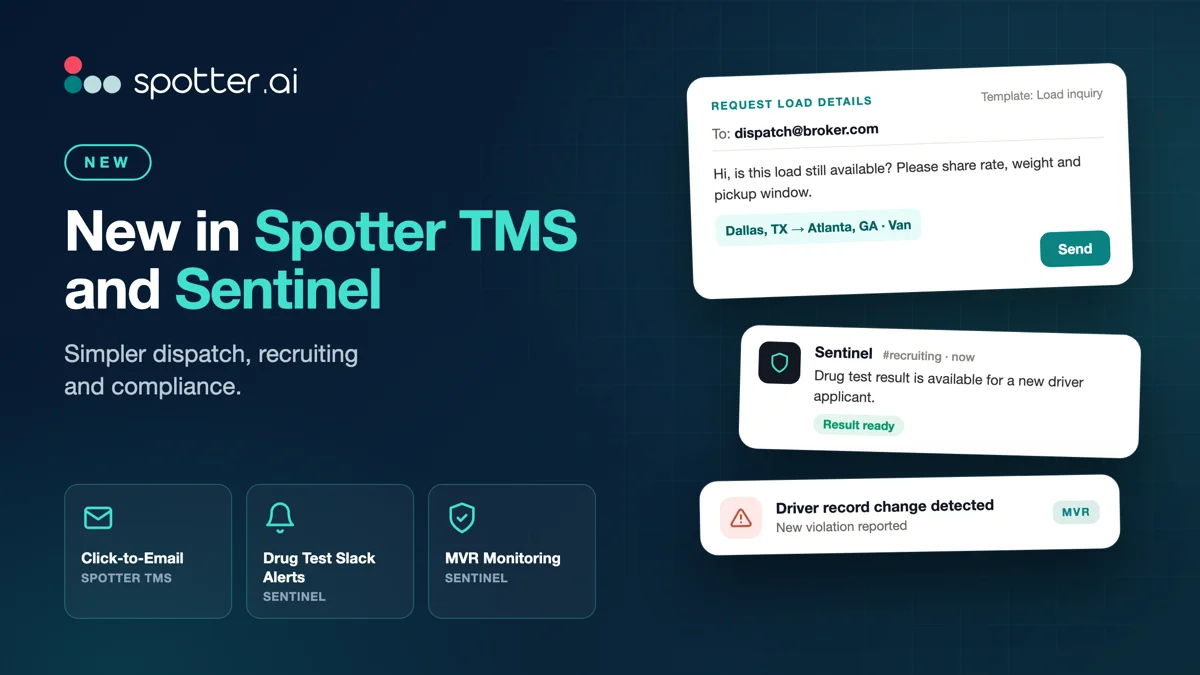
Spotter AI Introduces New Spotter TMS and Sentinel Features to Simplify Dispatch and Compliance

Spotter AI Launches Freight Forecast Newsletter for Weekly Market Intelligence

© 2026 spotter.ai. All rights reserved. · 251 Little Falls Dr. Wilmington DE 19808


